
From setting up cutting-edge facilities to cater to the domestic market and building capabilities of global standards, the action is building up.

Operating margins have been the primary driver of corporate earnings in India in recent quarters, despite revenue growth suffering from weak consumer demand. Companies across sectors have reported a sharp improvement in earnings before interest, tax, depreciation, and amortisation (Ebitda) margins over the past two years, benefiting from lower commodity and energy prices. Higher margins more than compensated for slower revenue growth, resulting in double-digit growth in net profit for five consecutive quarters.
Stock Market News today, PSU banks: The year 2024 was a roller-coaster ride for Indian stock markets, marked by volatility driven by the Lok Sabha elections, Union Budget 2024, a slowdown in corporate earnings, and sticky inflation. Geopolitical tensions - particularly between Israel and Iran in West Asia - along with various stimulus announcements by China and yen carry trade rocked the equity markets throughout the year.

The Reserve Bank of India (RBI) is expected to cut interest rates for the first time in nearly five years in Governor Sanjay Malhotra's first monetary policy committee (MPC) meeting on Wednesday. The meeting of the six-member MPC, which will culminate on Friday, aims to boost sluggish economic growth, which is seen falling to a four-year low. Malhotra took charge as the 26th RBI governor in December last year.

The stock of online classified major Info Edge (India) was up over 6 per cent on Friday on expectations of demand improvement for Indian IT companies. Strong revenue growth prospects for each of its online verticals - including recruitment, matrimony, real estate, education, and upside from its holdings in companies such as Zomato - had prompted Goldman Sachs to upgrade the stock. Info Edge's standalone revenue grew 10.6 per cent year on year (Y-o-Y) in Q2FY25, beating consensus. 99acres (+16.9 per cent Y-o-Y) and Jeevansathi (+33 per cent Y-o-Y) were drivers of growth while recruitment grew 8.5 per cent Y-o-Y.

In this round, the market has won. But it is still for Gautam Adani to decide whether he has lost or not, argues Shekhar Gupta.

Delhi-based electric vehicle (EV) ride-hailing firm Evera Cabs, which grabbed headlines after acquiring 500 cars from the now-defunct cab service BluSmart, is stepping up its presence in the EV cab segment. The company is aiming for revenue of Rs 100 crore in the ongoing financial year (2025-26), up from Rs 18 crore in 2024-25.

Market reaction to the Union Budget was overall neutral. The income tax "gift" wasn't enough to move the needle. There was some apparent rationalisation of Customs duty structure as well as cuts on import duties of some key components for the telecom and IT industry and duty cuts on vehicle imports. Other proposals related to development of agriculture and rural economy and renewables seem to be generally positive.

Equity markets would be mainly driven by global trends and foreign fund trading activity in the holiday-shortened week, analysts said. The BSE and the National Stock Exchange have listed March 7 (Tuesday) as a holiday on account of Holi. However, stock brokers' association ANMI has urged the government, exchanges and Sebi to shift the holiday to March 8 from March 7.

Equity benchmark indices ended flat on Wednesday with Sensex sliding 33 points and Nifty gaining 9 points after an unabated record-breaking rally in the last few trading sessions. Weak global market trends and fall in HDFC twins also spoiled markets party. The 30-share BSE Sensex dipped 33.01 points or 0.05 per cent to settle at 65,446.04.

Cement manufacturers' show during the June 2023-ended quarter (Q1FY24) has indicated an intensified slugfest for market share. For instance, Dalmia Bharat (Cement) said it has lost market share in eastern India owing to lack of price discipline. Industry analysts also said that the seasonal weakness in cement prices for Q1 is showing up earlier than usual.

Global markets trends, inflation, release of industrial output data and quarterly earnings will dictate movement of the equity benchmarks this week, analysts said, adding that volatility might continue amid slew of announcements of macroeconomic data at the global level too. Moreover, foreign fund movement, crude oil prices and trend in rupee would also act as major drivers for the equity market, they added. "The direction of global equity markets along with movement in dollar index and crude oil prices will continue to dominate while inflation numbers of the USA on May 11 and inflation and IIP numbers of India on May 12 will also cause volatility in the market," said Santosh Meena, head of research, Swastika Investmart Ltd.

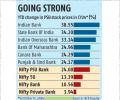
Shares of state-owned bank stocks were under pressure on Monday due to muted deposit and credit growth numbers reported by these lenders in the October-December quarter (Q3) of 2024-25 (FY25). The Nifty PSU Bank index was down 4 per cent, with Union Bank of India emerging as the biggest loser as its shares fell 7.5 per cent to close at Rs 114.7, followed by a 5.7 per cent drop in shares of Bank of Baroda (BoB) to Rs 228 and a 4.7 per cent slide in shares of Bank of India to Rs 99.8 on the National Stock Exchange.

From the Sensex basket, Titan, Reliance Industries, Asian Paints, Tech Mahindra, IndusInd Bank, UltraTech Cement, Wipro and ITC were the major laggards. ICICI Bank, Infosys, Bajaj Finserv, Tata Steel, Axis Bank, Bajaj Finance, Nestle and Mahindra & Mahindra were among the major gainers.

Attractive pricing coupled with improving prospects make the offer lucrative

With the rapid evolution of channels like quick-commerce and the emergence of ONDC, the Indian retail industry is 'cautiously optimistic' for 2025, in which new-age technologies such as AI and automation will play a crucial role, driving efficiency and personalisation.

Small stocks of Dalal Street grappled with turbulent times in 2022 as high volatility and higher interest rate regime sapped investors' appetite for these scrips but the horizon ahead seems less cloudy for the New Year. While the 30-share Sensex scaled multiple record peaks with bluechips glittering, small stocks underperformed and the BSE smallcap index declined more than 3 per cent this year. In comparison, the BSE Sensex climbed 2,673.61 points or 4.58 per cent till December 27.

Benchmark equity indices climbed nearly 1 per cent on Wednesday on buying in HDFC Bank and Reliance Industries. Investors are eyeing the two important events lined up ahead -- the interim budget and the US Fed interest rate decision -- to derive further cues from. Recovering all the early lost ground, the 30-share BSE Sensex jumped 612.21 points or 0.86 per cent to settle at 71,752.11.

Finance Minister Nirmala Sitharaman on Saturday announced six new schemes and increased the subsidised Kisan Credit Card (KCC) loan limit to Rs 7 lakh from Rs 5 lakh, targeting everything from unemployment to crop productivity enhancement across the country. Presenting her eighth budget speech in Parliament, Sitharaman positioned agriculture as "the first engine of growth" and unveiled the Prime Minister Dhan-Dhaanya Krishi Yojana, a flagship program targeting 100 agri-districts grappling with low productivity, moderate crop intensity, and below-average credit parameters.

Contrary to popular perception of public sector oil firms making huge profits on selling petrol and diesel by gold plating the cost, Indian firms have second lowest refinery and marketing margins - profits - in the world.

FMCG major Hindustan Unilever Ltd on Wednesday reported a 19.18 per cent rise in consolidated net profit at Rs 2,989 crore in the December quarter.

Benchmark equity indices ended marginally higher on Thursday, trimming most of their intra-day gains, as investors turned cautious ahead of the quarterly results of IT behemoths TCS and Infosys later in the day. Announcement of the US inflation data and domestic macroeconomic numbers also forced investors to remain on the sidelines. The 30-share BSE Sensex climbed 63.47 points or 0.09 per cent to settle at 71,721.18.

Foreign portfolio investors' (FPIs') shareholding in NSE-listed companies fell 51 basis points sequentially to 17.68 per cent in the quarter ended March 31, 2024, according to data compiled by PRIME Database. This is the lowest FPI shareholding since December 2012. From the recent peak of 21.21 per cent at the end of December 2020, FPI shareholding is down 353 basis points.

After a spike in crude oil and gas prices in October following the Hamas terror attack, prices eased down 9 per cent month-on-month in November. The Organization of the Petroleum Exporting Countries (Opec) and Opec+ agreed to a further voluntary production cut in January-March 2024 to try and support global crude prices. The best guess here is that crude prices (currently at $75/barrel, or bbl) will not likely cross significantly above $80, and gas prices are also likely to remain subdued unless there's a further escalation in the Israel-Hamas conflict.

'Market feels this Budget will promote all-round growth and that is what is giving it confidence.'

'The markets seem apprehensive and that explains why the markets have been feeling slightly uncomfortable ahead of the Budget.' 'After the event, when all the concerns are resolved and clarity emerges, markets will decide what to do next.'

The Indian IT services sector is staring at a second consecutive year of muted revenue growth due to modest increase in tech spends in Europe and the US, a domestic rating agency said on Wednesday. Crisil Ratings said it expects the sector to grow at 5-7 per cent in FY25, after a growth of 6 per cent estimated to have been achieved in FY24. The overall industry size is pegged at $250 billion and it creates over 50 lakh direct jobs.

From its lows this month, the stock of Bharti Airtel is up 14 per cent. The gains for the telco have come on the back of expectations that market share consolidation, tariff hike and lower capex should boost margins and profits. While the company is a key player in the Indian market, it also has a leadership position in major markets of Africa.

More companies are harbouring aspirations to go public, following a sharp market rebound after June's nadir. In August, seven companies expecting to raise a cumulative Rs 10,425 crore filed their draft red herring prospectus (DRHP) with the Securities and Exchange Board of India (Sebi). The amount they are looking to mop up is the highest since March, when 13 companies filed their DRHPs to raise a combined Rs 19,494 crore, reveals data provided by PRIME Database - a source of comprehensive information on all capital market offerings.

Growth in corporate profits needs to be commensurate with wages to boost the economy, Economic Survey 2024-25 said, noting that sharp disparities between the two pose risk to the economy by curbing demand. The document tabled in Parliament on Friday noted that while the labour share of GVA (gross value added) shows a slight uptick, the disproportionate rise in corporate profitsredominantly among large firmsaises concerns about income inequality.

'Markets are factoring in a good show by India Inc in Q2.'

The growth in India's domestic aviation capacity in calendar year 2023 (CY23) was the sixth highest among 20 major domestic markets, compared to the pre-pandemic year of CY19. The domestic capacity in the country surpassed the pre-pandemic level seen in CY19 and was up 5 per cent in CY23. It trails Mexico, Columbia, China, Vietnam, and Spain, which have shown higher growth, according to data shared in a seminar organised by global travel data provider OAG on global aviation trends in 2023.

The recent depreciation of the rupee along with sharp fall in the country's foreign exchange (FX) reserves has sparked a debate whether stability of the exchange rate is necessary and desirable. The rupee was one of the least volatile currencies among peers for almost two years before the current downward pressure started in September after the US Federal Reserve lowered interest rate.

The markets may be entering a consolidation phase and are expected to trade sideways for now after a good run in the last few weeks, suggest analysts. In this backdrop, they suggest investors can book profits at the current levels and enter the market again on a decline from a medium-to-long term perspective. Thus far in fiscal 2023-24 (FY24), the S&P BSE Sensex has moved up around 5 per cent to nearly 62,000 levels.

The headline for corporate profit growth has been very encouraging in the July-September quarter (Q2) of 2023-24 (FY24), with the combined net profit of listed companies up by 38 per cent year-on-year. However, the earnings distribution has been very lopsided, with most of the growth coming from public-sector oil-marketing companies (OMCs), banks, non-bank lenders, automobile (auto) companies, and cement producers. By comparison, companies from information technology services, fast-moving consumer goods (FMCG), retail, and consumer durables were disappointed, experiencing a sharp slowdown in net sales growth and a relatively muted increase in reported net profit.

After declining for three consecutive quarters, the value of FPI investment in Indian equities rose 8 per cent quarter-on-quarter to $566 billion in the July-September period, according to a Morningstar report on Wednesday. A fast-changing global macroeconomic landscape, sentiments and opportunities that the Indian equity markets have to offer impacted the direction of flows by Foreign Portfolio Investors (FPIs). Through the quarter, the value of the FPI holdings in domestic equities surged by 8 per cent to $566 billion from $523 billion recorded in the previous quarter.

The revenue growth of Indian companies for the July-September quarter is estimated to be 5-7 per cent year-on-year (Y-o-Y), marking the slowest growth in 16 quarters, rating agency CRISIL said on Thursday.

Macroeconomic (macro) concerns, along with a cautious approach towards discretionary information technology (IT) spending, will see the revenue for Indian IT firms decelerate by 5 per cent through 2024-25 (FY25), from the highs of 12-18 per cent in 2022-23, said analysts from S&P Global Ratings. "The reason behind this slow growth is a macro slowdown. "Customers are cutting their discretionary IT spending, especially on projects that take longer to deliver quantifiable outcomes. "We also acknowledge that there are still strong economic headwinds for the next few years," said Spencer Ng, associate director, corporate ratings, S&P Global Ratings, over a call in a media briefing.

Just ahead of its mega FPO opening to public investors, Vodafone Idea (VIL) has announced closure of its anchor book allocation, raising about Rs 5,400 crore from marquee global as well as domestic investors, according to a statutory filing by the telco. This could be the third-largest anchor book after One 97 Communications and Life Insurance Corporation (LIC). One 97 Communications and LIC had raised Rs 8,235 crore and Rs 5,627 crore in the anchor round, respectively.

Trading volumes for the equities cash segment remained soft, even as the benchmark indices rallied nearly 9 per cent in July. Meanwhile, volumes in the futures and options (F&O) market dipped marginally, but continued to hover at record levels. In July, the average daily turnover (ADTV) for the cash segment was Rs 46,602 crore, up 4.5 per cent month-on-month (MoM), but 26 per cent lower than the preceding 12-month average.
